
The rise of expletives
For my PhD (2018, University of Manchester) I examined the development of the expletive það over nine centuries of Icelandic, from the earliest texts to the present day.
I presented a diachronic account for the change, set against the backdrop of Icelandic clause structure, with particular attention to verb-second, information structure and the left periphery.
I showed that the Icelandic development challenges the established consensus on the diachrony of Germanic expletives.
More recently, I took a closer look at the status of það in a type of cleft construction which is very frequent in the Sagas of Icelanders, the time-cleft (‘It was one time that…’ ).
In a recent paper, I showed that the obligatory status of það in these constructions further challenges standard assumptions about how expletives develop, indicating that discourse-pragmatic aspects can play an information-structural role even at an early stage
Verb position, topics and subjects
My work on the rise of expletives showed that it was intimately connected with other changes and fed into a collaboration with Christin Beck (née Schätzle) at the University of Konstanz.
Together, we argued that the decreasing frequency of verb-first order is related to the ongoing emergence of a dedicated subject position from an older topic position.
To account for these changes, we developed a theoretical analysis using Lexical Functional Grammar, which allowed us to neatly capture the changing associations between syntactic position and information structure.
The configurationality debate
I recently revisited the status of Old Icelandic with respect to configurationality – a matter of hot debate in the early 1990s.
I argued that the matter can be given new light by assuming the LFG perspective, where argument configurationality is a gradient property concerning the extent to which a language encodes grammatical relations via structural means, and where subtle changes over time are expected.
Discourse devices in the sagas
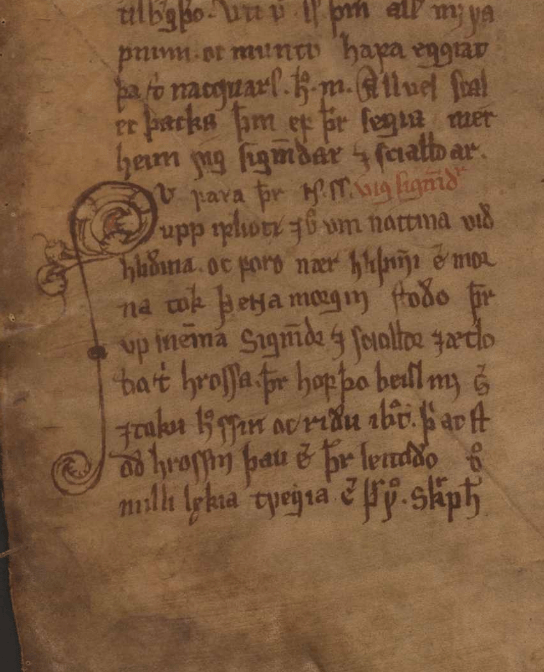
I have also looked at linguistic devices employed in the Sagas of Icelanders (Íslendingasögur), especially those connected with information structure.
Previously I examined the proprial article (hann Jón, ‘he John’) in the sagas, showing that its pragmatic properties go beyond a simple given/new distinction as previously assumed. Instead, I argued that the proprial article as this early stage functions as a topic management device signalling various types of topic-shift, and for coordinating referents which have an asymmetric topical status.
More recently, I have examined the role of clause-medial temporal/spatial adverbs (þá, þar, nú), arguing that they mark an information-structural watershed, segmenting the clause into discourse domains. I also showed that, diachronically, these adverbs are in complementary distribution with the expletive það, which later takes on some of the same functions.
 Hannah Booth